 by
by
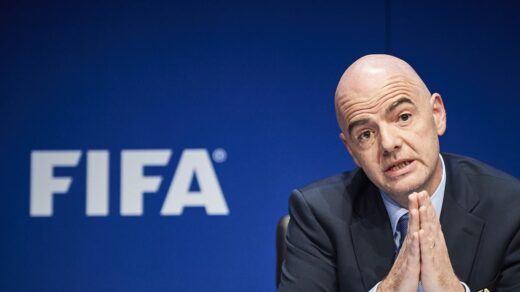
Somalia has defended award-winning referee Omar Artan after he was denied entry to the United States and prevented from becoming the first Somali official to officiate at a World Cup.
Somalia’s Ministry of Sports expressed “deep regret” over Artan’s denial of entry, saying that despite diplomatic engagement with US authorities and world football’s governing body FIFA, it was “not possible to achieve a positive outcome”.
Artan, who in 2025 was named men’s referee of the year by the Confederation of African Football (CAF), was barred from entering the US on Saturday after arriving at Miami International Airport.

Get all the latest football news, highlights and analysis delivered straight to your inbox with Fox Sports Sportmail. Sign up now >
FIFA then confirmed that he would no longer be part of the quadrennial football extravaganza set to start on Thursday.
Artan’s appointment to the 52-strong roster of referees for the finals in Canada, Mexico and the United States had been a huge source of pride for his compatriots.
Somalia’s president Hassan Sheikh Mohamud said in April he was “a symbol of inspiration for the new generation of Somalis”.
A spokesperson for the US Customs and Border Protection (CBP) said Artan was denied entry following a routine inspection.
Somalia is one of several countries on a travel ban list introduced by President Donald Trump’s administration as part of a broader immigration crackdown.
Oyarzabal smashes ominous Spain in front | 00:31
A CAF source told AFP the continental body could not intervene in the decision by the US, adding: “We certainly feel sorry for Artan.”
Somalia reaffirmed “its unwavering support” for the referee, adding it “has full confidence in his integrity, professionalism, and continued contribution to the advancement of football both in Somalia and internationally.”
“Artan represents the very best of Somali talent,” the Ministry of Sports statement said.
Artan said in an interview with the New York Times that the “biggest dream of my life” had been ripped away.
“I am very, very disappointed,” he said from Istanbul, where he returned after being turned back in Miami.
“I’m just simply a referee who’s trying to live his dream, the biggest dream of my life, to come to the World Cup.”
Artan said he was subjected to an 11-hour interview with border officials and then taken to a separate holding cell where he was detained for several further hours before being put on a flight back to Turkey.
“I had the right papers and everything. I had the right visa,” he added – an assertion confirmed to AFP by a Somali government adviser.
Artan’s rejection has sparked outrage at home.
Former Somali Prime Minister Hassan Ali Khaire said he was “deeply disappointed” and assured Artan that “Africa and the world stand with you.”
“He represents not only Somalia, but also the aspirations of millions of young Africans who believe excellence should be recognised on the world stage,” Khaire wrote on X.
Ex-Somali government minister Abdirashid Hashi called on FIFA to stand with Artan, saying, “Football is supposed to unite people, not exclude.”
He “should be judged by his merit and professionalism — not by the passport he carries,” Hashi added, describing the move as a “political decision” by the United States.
Hashi suggested that FIFA could have allowed the referee to take charge of World Cup games in the two other countries hosting games.
“I hope Canada and Mexico issue visas to Artan. There is no reason a referee denied entry to one host country cannot still contribute to a World Cup being hosted across three countries,” he said.
Protesters block road to Mexican World Cup stadium
Thousands of demonstrators blocked an avenue leading to Mexico City’s Azteca Stadium on Tuesday, just days before the 2026 World Cup kicks off at the venue.
As football fans flood into tournament co-hosts the United States, Canada and Mexico, the Central American country is grappling with chaotic teacher protests in its capital.
Tuesday’s protest, led by a breakaway group of the CNTE teachers union, follows a week of demonstrations that President Claudia Sheinbaum has called a “provocation.”
“As if to say, ‘Look at how bad the situation is in Mexico,’” she told a press conference.
The Azteca stadium will host the World Cup’s first game – pitting Mexico against South Africa – on Thursday, with a vast global TV audience set to tune in for the opening ceremony and the match.
Authorities have deployed thousands of officers and set up concrete barriers surrounding the venue to block protests.
“We intend to reach the stadium,” demonstrator Angel Villalobos told AFP on Tuesday.
“The government has given some responses, but they don’t help, they don’t satisfy.” Sheinbaum said earlier that the opening match was “guaranteed,” though the left-leaning leader again ruled out using police to repress the demonstrations.
Her government has favoured dialogue with the protesting teachers, but to no avail.
Yengi on debut goal vs. Switzerland | 00:53
“We’re going to continue our struggle,” said Austreberto Flores, another protester looking to block Azteca Stadium.
The CNTE teachers union has been on strike since last week to demand a salary raise and the reversal of a pension law — which the government considers unfeasible.
The teachers have also set up camp near the World Cup fan zone in Mexico City’s Zocalo square.
On June 1, police dispersed protesters in the area with rubber bullets and teargas.
“They want to make it seem like there is mass social turmoil in Mexico, and that’s not true,” Sheinbaum has said of the protests.
The teachers have called for demonstrations on Thursday that will also include families of so-called “disappeared” people, who are alleged to have been killed or kidnapped by Mexican authorities or criminal gangs.
The 2026 edition of the world’s biggest football extravaganza is the most logistically complex ever staged.
Mexico is still rushing to complete renovations at subway stations and at its main airport ahead of the tournament.